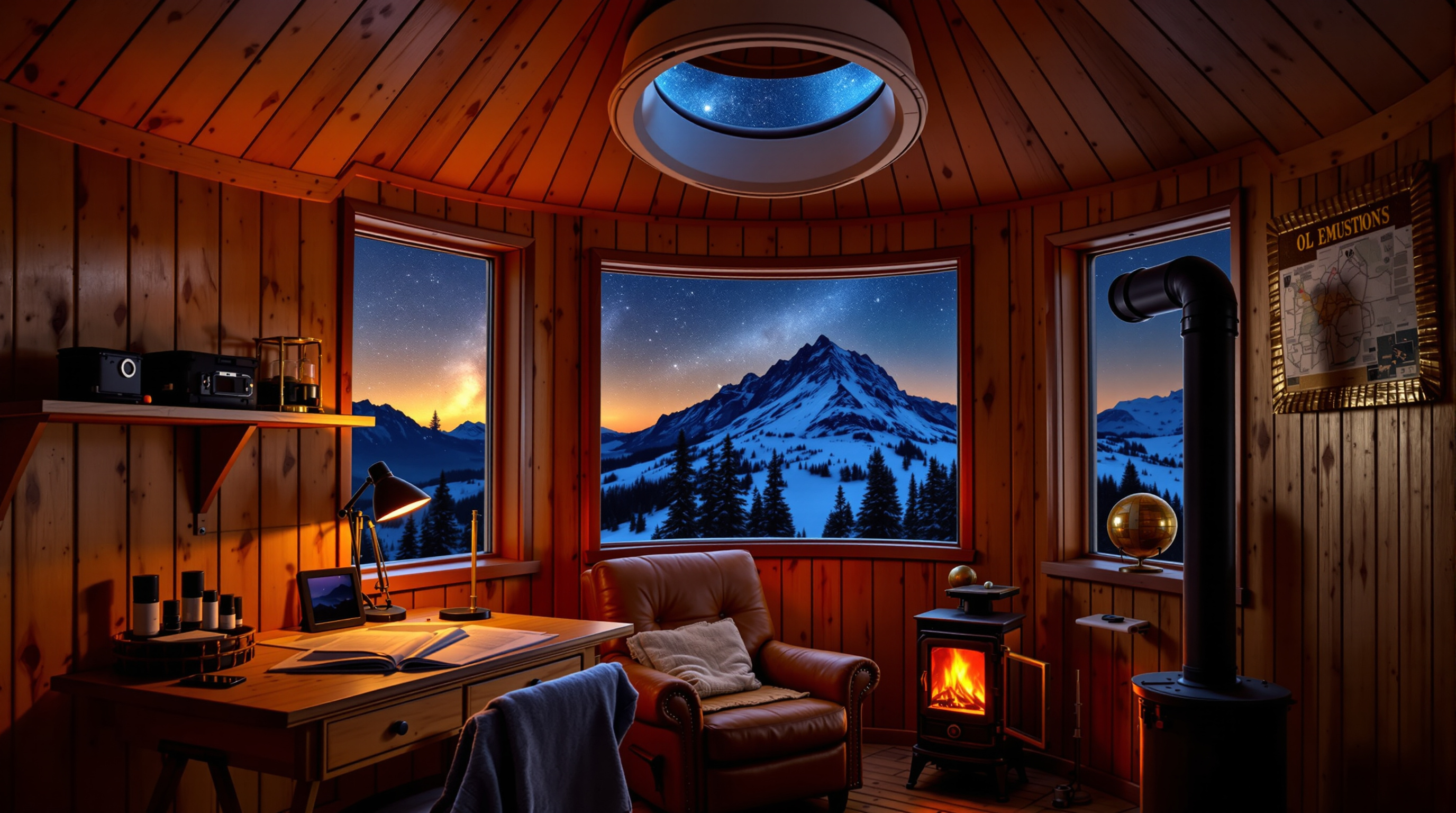
Photoreal night interior of the same cedar observatory cabin: desk with star charts and a red lamp, telescope eyepiece to the white dome hatch, cast-iron wood stove with stovepipe, leather armchair, and two amber front windows framing the mountain ridge and Milky Way. Step 3 of the Mountain Observatory Cabin workflow.
Interior room of a small cedar observatory cabin at night: walls and ceiling of warm vertical cedar boards matching the exterior, a wooden desk with open star charts and a red-glowing desk lamp, a telescope eyepiece and black telescope tube angled up through a ceiling hatch into the white hemispherical dome above, and a small black cast-iron wood stove with orange firelight and a black steel stovepipe. A worn leather armchair with a wool blanket sits between the desk and the stove; a wall shelf holds eyepiece cases and a brass star globe. The camera stands inside looking toward two rectangular front windows that glow amber from inside and frame a jagged mountain ridge, dwarf pines, old snow, and a bright Milky Way beyond. Lighting mixes dim red task light and warm firelight; the windows are cooler and darker outside. Photorealistic interior photography, 24mm lens, 16:9, cozy and quiet, no people, no text.
Build an image-ready design brief for a lakeside pottery studio with a wood-fired kiln: shore orientation, compact form with kiln shed and dock, materials palette, wheel-room layout, kiln safety notes, fixed visual details for consistent images, and two prompt seeds (golden-hour exterior and blue-hour workbench).
Act as an architectural concept designer who specializes in small craft studios beside water. Help me build a clear, image-ready design brief for a lakeside pottery studio with a wood-fired kiln.

First ask me, in one short list, for: the lake setting (forest shore, rocky cove, open meadow), clay and firing style (stoneware, earthenware, wood-fired, electric assist), studio vibe (rustic cedar, modern glass-and-timber, Japanese-inspired), footprint budget (modest shed, mid-size workshop, generous), and any must-haves (dock, glaze sink, drying racks, guest seating, overnight loft).

Then produce the brief with these sections:

1. **Concept in One Sentence**: the feeling and purpose of the studio.
2. **Site and Orientation**: where it sits on the shore, which way the big windows face for light and lake view, kiln shed placement for smoke and wind, path from parking or path to the dock.
3. **Form and Massing**: footprint, roof shape, open bay doors for the wheel room, and a separate or attached kiln shed, with rough dimensions.
4. **Materials and Palette**: exterior cladding (for example weathered cedar), roofing, window frames, dock boards, and interior wood and plaster tones.
5. **Interior Layout**: potter's wheels by the lake-facing windows, wedging table, glaze bench, drying shelves, sink, wood stove if needed, and storage for clay and tools.
6. **Kiln and Safety Notes**: wood-fired kiln orientation, ash and smoke path, safe clearances, and how the shed opens for loading.
7. **Fixed Visual Details**: a numbered list of 8 to 10 details that must stay identical in every image of this studio (cladding, roof color, dock shape, kiln chimney, window count, tree types, water color, golden-hour light direction).
8. **Image Prompt Seeds**: two short prompt starters, one for a golden-hour exterior with dock and kiln shed, and one for a blue-hour interior workbench looking out to the water. Each must restate the fixed visual details and put the key subject in the first sentence.

Keep it concise, practical, and buildable. Avoid naming real architects or brands. Flag anything unsafe for wood firing near trees or a dock.
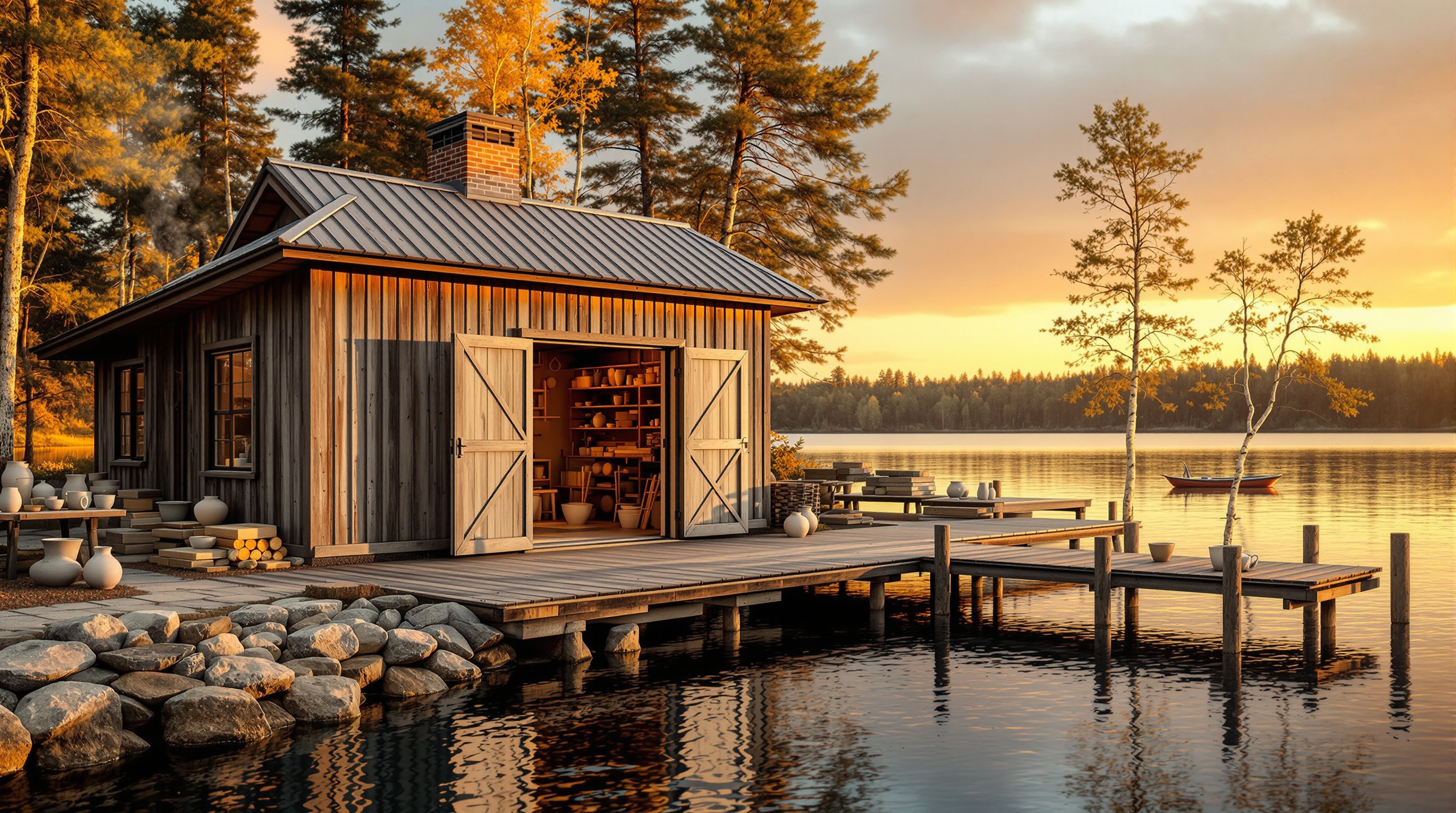
Photoreal golden-hour exterior of a weathered cedar pottery studio on a lake dock: open bay doors showing wheels, separate wood-fired kiln shed with brick chimney, stacked firewood, pines, calm water reflections. Step 2 of the Lakeside Pottery Studio workflow.
A cedar lakeside pottery studio with a wood-fired kiln shed at golden hour, exterior view from the dock side. Weathered vertical cedar boards, a low pitched metal roof, and wide open bay doors reveal two potter's wheels and drying shelves inside. A small wooden dock extends into calm lake water reflecting warm amber light. Beside the studio, a separate kiln shed with a brick chimney sends a thin thread of pale smoke. Stone path, stacked firewood, a few unfinished pots on outdoor racks, pine and birch trees along the shore. Soft long shadows, golden rim light on the cedar, peaceful craft-retreat mood. Photoreal, landscape 16:9. No people, no text, no cars.
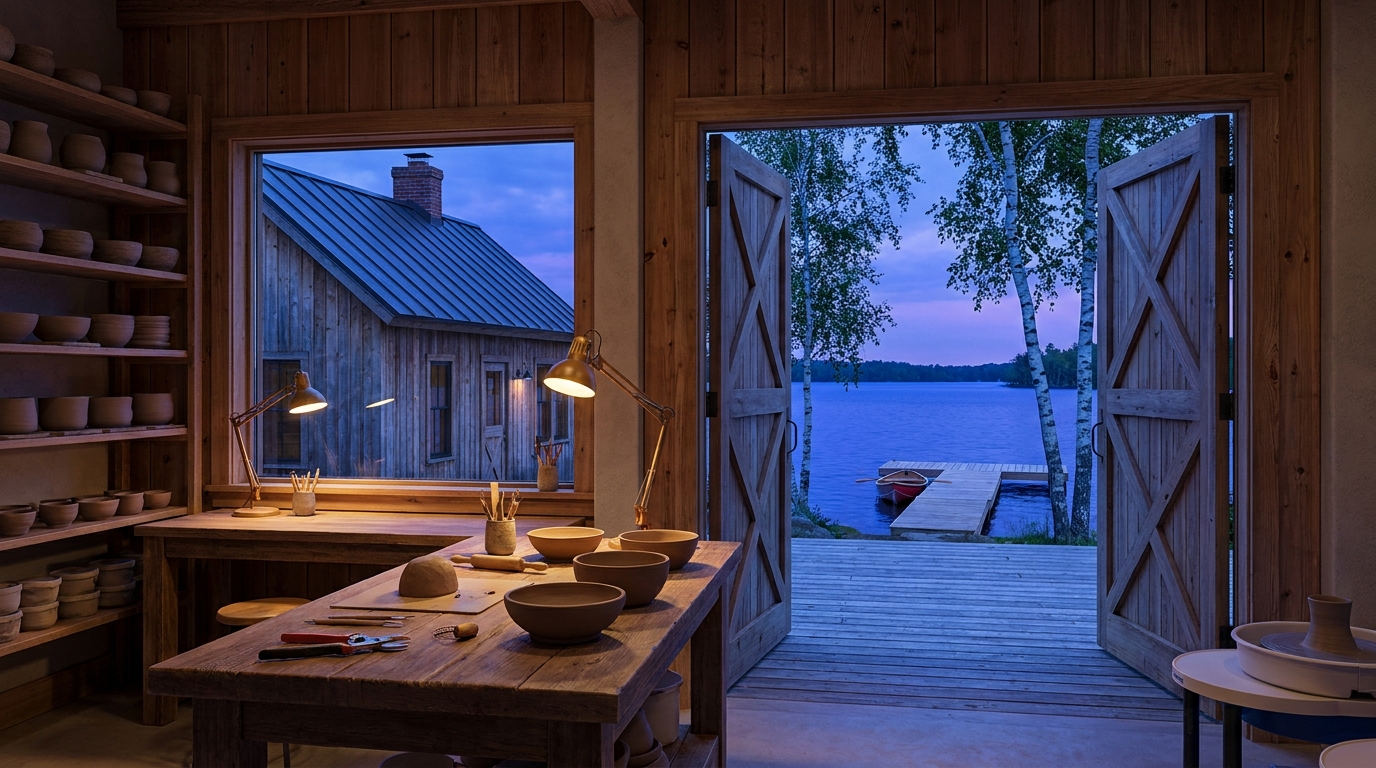
Photoreal blue-hour interior of the lakeside pottery studio: wedging workbench with clay tools, shelves of drying pots, wide window to violet lake dusk, dock and kiln chimney visible outside. Warm lamp vs cool window light. Step 3 of the Lakeside Pottery Studio workflow.
Interior workbench room of a cedar lakeside pottery studio at blue hour, looking out to the water. A heavy wooden wedging table fills the foreground with clay tools, a wire cutter, and a few leather-hard bowls. Shelves of drying pots line the left wall. Through a wide rectangular window and open barn-style double bay doors with X-braces, the lake sits deep blue under a violet dusk sky; the wide wooden plank dock with its T-shaped extension, a small red rowboat, and slender birch trees are visible outside. Warm task lamp light on the bench contrasts cool blue window light. Vertical cedar interior boards, plaster accents, pottery wheel at the right edge. Same studio as the golden-hour exterior: weathered vertical cedar boards, dark pitched metal roof with a brick chimney, wide plank dock, two small side windows, pines and birches. Photoreal, landscape 16:9. No people, no text.
Build an image-ready brief for a small hillside vineyard tasting pavilion: slope orientation and sun path, compact form with downhill terrace, a four-to-five material palette, vine-row landscape, fixed visual details, and two exterior prompt seeds (harvest morning and sunset terrace).
Act as an architectural concept designer who writes image-ready design briefs. Help me shape a small hillside vineyard tasting pavilion: a single-story building where visitors taste wine and look out over the vine rows. Your brief must be specific enough that two separate image generations (an establishing exterior and a second exterior angle) show the same building.

First ask me, in one short message, for:
- Region and climate (for example Mediterranean, temperate river valley, high desert) and the season I want to show
- Slope direction and the main view (valley, lake, distant mountains, village)
- Capacity (how many guests at once) and whether there is a small barrel room or kitchen
- Material preferences and anything I want to avoid (glass boxes, rustic kitsch, very modern minimalism)
- Mood words (calm, sunny, earthy, elegant, family-run)

Then produce the brief with these sections:

1. **Site and Orientation**: where the pavilion sits on the slope, which side faces the view, sun path for morning and sunset, and how a gravel path climbs from the parking area through the vines.

2. **Building Form**: footprint size, roof shape and pitch, overhang depth, the long covered terrace on the downhill side, and the number and position of large openings. Keep it compact and believable.

3. **Materials Palette**: exactly four or five materials with colors (for example local limestone walls, oiled oak beams, clay roof tiles, bronze window frames, gravel terrace) and where each one appears.

4. **Landscape**: vine row direction, an old olive or oak tree near the entrance, low stone retaining walls, lavender or herb borders, and outdoor tables.

5. **Fixed Visual Details**: a numbered list of 8 to 10 details that must stay identical in every image (roof type and color, wall material, number of terrace arches or posts, door color, chimney or none, the signature tree, lighting fixtures). These details make the images consistent.

6. **Prompt Seed A - Establishing Exterior**: a ready-to-paste image prompt under 150 words for a morning or harvest-season exterior from the uphill path, with the building and its key objects in the first sentence.

7. **Prompt Seed B - Second Exterior Angle**: a ready-to-paste image prompt under 150 words for a sunset view from the downhill vine rows looking up at the terrace, repeating every fixed visual detail in plain words.

8. **Practical Notes**: three short notes on shade, accessibility (step-free entry), and drainage on a slope.

Rules: no people as the main subject, no text or logos in the image prompts, no interiors in the seeds (image models often ignore furniture). Use short paragraphs and lists.
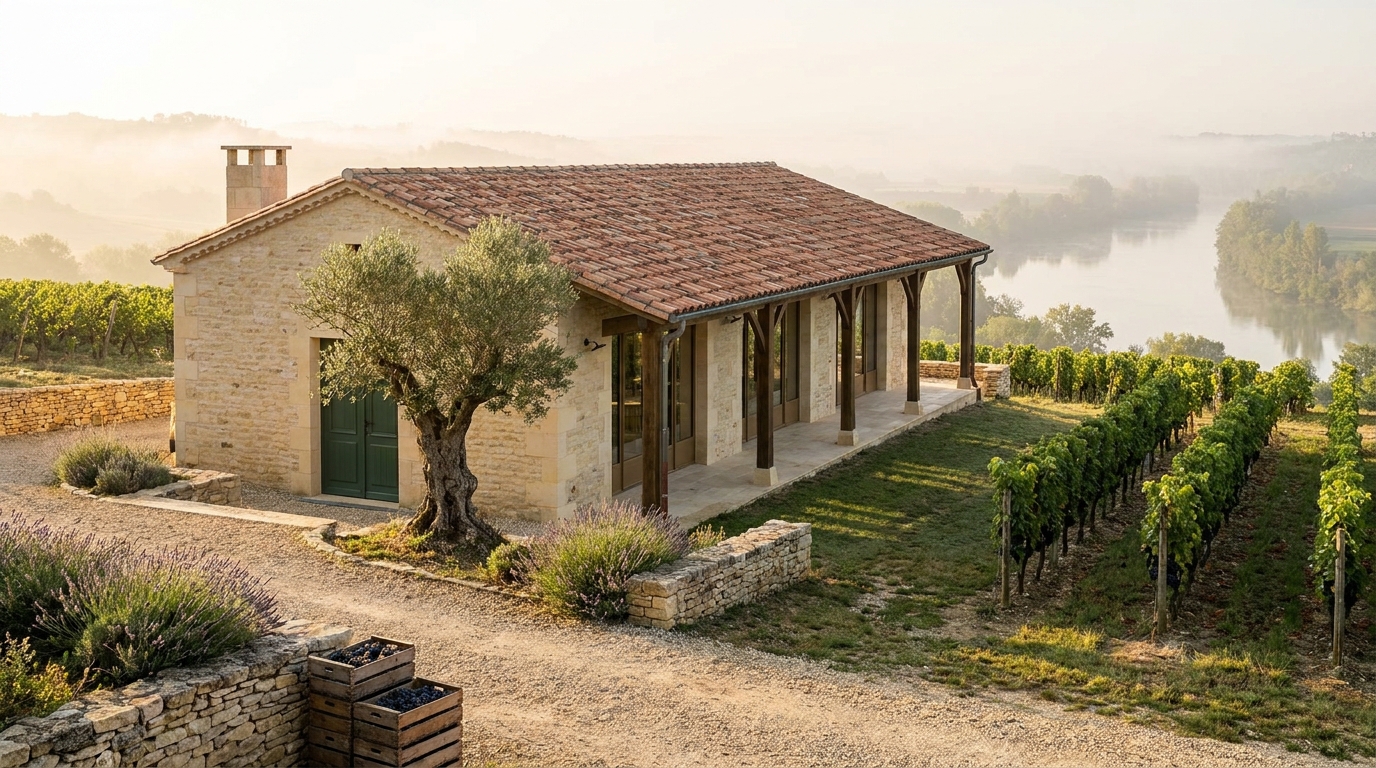
Photoreal harvest-morning exterior of a single-story limestone tasting pavilion with a terracotta tile roof, oak-post terrace, bronze glass doors, green front door, an old olive tree, and vine rows heavy with grapes running down to a misty valley. Step 2 of the Vineyard Tasting Pavilion workflow.
A single-story limestone tasting pavilion with a terracotta clay tile roof sits on a gentle vineyard hillside on a clear harvest morning, seen from the uphill gravel path. Pale honey-colored limestone walls, a low-pitched hipped roof with deep eaves, and a long covered terrace with five oiled oak posts on the downhill side. Tall bronze-framed glass doors and a deep green wooden front door. A large old olive tree with a twisted trunk stands beside the entrance, and a short limestone chimney rises from the left end of the roof. Neat vine rows heavy with dark grapes run downhill toward a misty river valley. Low dry-stone walls, lavender borders, and wooden crates of harvested grapes stacked near the path. Soft golden side light, long morning shadows, light haze in the valley. Photoreal architectural photography, landscape 16:9. No people, no text, no signs, no cars.
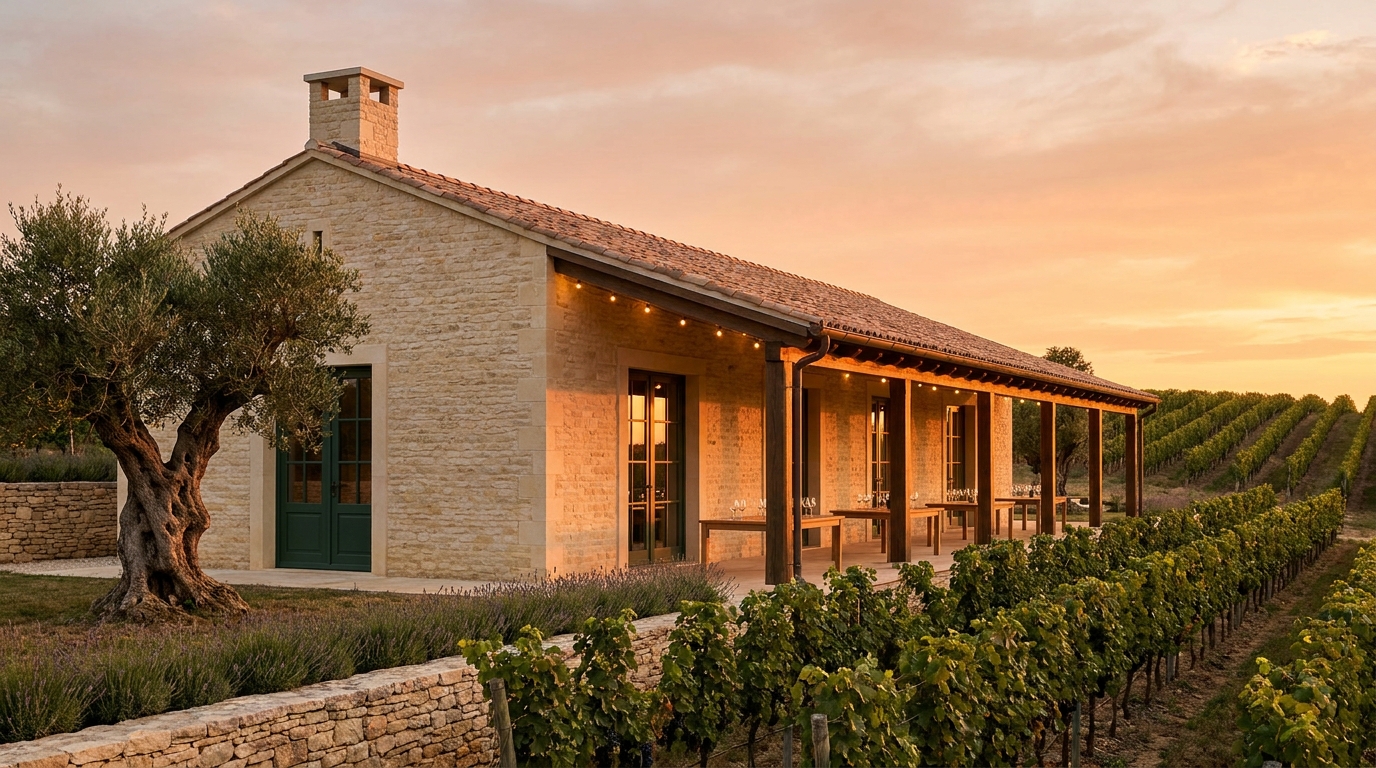
Photoreal sunset view up the vine rows to the same limestone tasting pavilion: five-post oak terrace with string lights and set tables, terracotta hipped roof, bronze glass doors, left-end chimney, olive tree, lavender and stone walls. Step 3 of the Vineyard Tasting Pavilion workflow.
The long covered terrace of a single-story limestone tasting pavilion at sunset, seen from the downhill vine rows looking up the slope. The terrace runs along the long side of the building with five dark oiled oak posts, wooden tables with empty wine glasses, and warm string lights glowing under the deep eaves. Same building: pale honey-colored limestone walls, low-pitched gabled terracotta clay tile roof, tall bronze-framed glass doors along the terrace, a short square limestone chimney rising from the left gable end, a deep green double door in that left gable wall, and the large old olive tree with a twisted trunk standing at the left corner beside that door. Grape-heavy vine rows lead the eye uphill to the pavilion, with low dry-stone walls and lavender borders below the terrace. Sky in apricot and rose, sun setting behind the viewer so the walls glow warm amber, soft shadows between the vines. Photoreal architectural photography, landscape 16:9. No people, no text, no signs, no cars.
Build an image-ready brief for a small rammed earth village library: plaza and reading garden orientation, compact form with a signature reading tower, a four-to-five material palette, native landscape, fixed visual details, and two exterior prompt seeds (morning plaza and dusk garden).
Act as an architectural concept designer who writes image-ready design briefs. Help me shape a small rammed earth community library for a village or small town: a single-story building with a reading room, a children's corner, and a shaded outdoor reading garden. Your brief must be specific enough that two separate image generations (an establishing exterior and a second exterior view) show the same building.

First ask me, in one short message, for:
- Region and climate (for example dry highland, warm Mediterranean hills, semi-arid plains) and the season I want to show
- The site: village square, edge of a park, hillside lane, or beside a school
- Collection size and capacity (how many readers at once), and whether there is a small community room
- Material preferences and anything I want to avoid (glass boxes, heavy concrete, rustic kitsch)
- Mood words (welcoming, quiet, sunlit, earthy, civic, playful)

Then produce the brief with these sections:

1. **Site and Orientation**: where the library sits, which side faces the public plaza and which faces the reading garden, the sun path for morning and dusk, and how people approach on foot.

2. **Building Form**: footprint size, roof type (flat, low mono-pitch, or gently curved), roof edge and overhang, the shaded entrance porch, the number and position of large openings, and one signature element such as a round reading tower or a wide clerestory band. Keep it compact and buildable.

3. **Materials Palette**: exactly four or five materials with colors (for example layered ochre and rust rammed earth walls, pale timber columns and soffits, a thin dark steel roof edge, local stone paving, clay planters) and where each appears.

4. **Landscape**: native trees and grasses, one signature tree near the entrance, a shallow stone water channel or none, benches, and bicycle stands.

5. **Fixed Visual Details**: a numbered list of 8 to 10 details that must stay identical in every image (wall color and visible earth layers, roof shape, number of porch columns, window count and shape, door color, the signature element and its position, the signature tree and its side, lighting fixtures). These details make the images consistent.

6. **Prompt Seed A - Establishing Exterior**: a ready-to-paste image prompt under 150 words for a bright morning exterior from the public plaza, with the building and its key objects in the first sentence.

7. **Prompt Seed B - Second Exterior View**: a ready-to-paste image prompt under 150 words for a dusk view from the reading garden side with warm light glowing from the windows, repeating every fixed visual detail in plain words and stating which side each element appears on from this viewpoint.

8. **Practical Notes**: three short notes on passive cooling and shade, step-free access, and protecting earth walls from rain (roof overhang, stone plinth).

Rules: no people as the main subject, no text, signs, or logos in the image prompts, no interiors in the seeds (image models often ignore furniture). Use short paragraphs and lists.
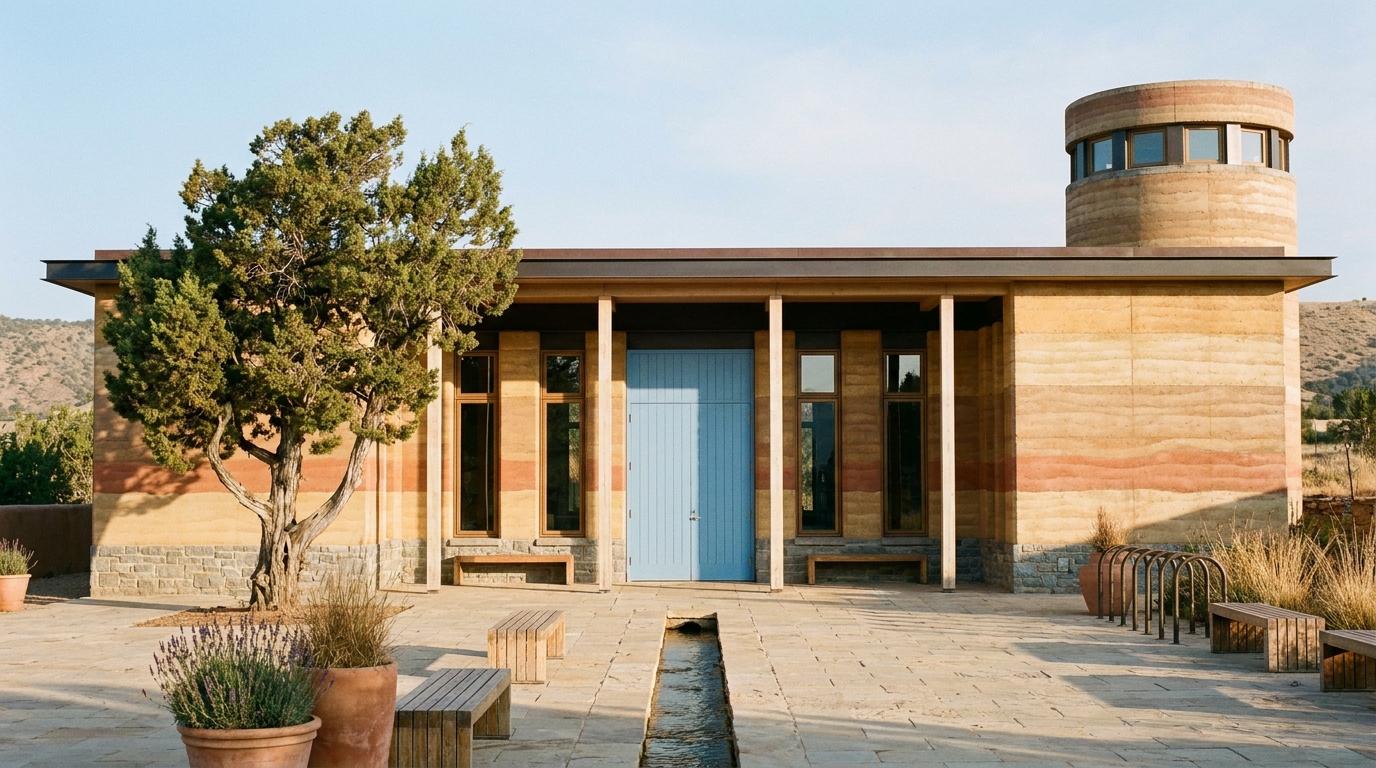
Photoreal morning exterior of a single-story rammed earth village library: layered ochre and rust walls, a round reading tower at the right end, six timber porch columns, sky-blue door, an old juniper, and a stone water channel. Step 2 of the Rammed Earth Village Library workflow.
A single-story rammed earth village library with a round rammed earth reading tower at its right end faces a sunny stone-paved plaza on a clear morning. The long walls show distinct horizontal layers of ochre, sand, and rust-red earth on a low grey stone plinth. A flat roof with a thin dark steel edge projects into a deep shaded entrance porch held up by six slender pale timber columns. Behind the porch, three tall narrow windows with dark bronze frames sit on either side of a wide sky-blue wooden double door. The cylindrical tower is slightly taller than the main roof, with a ring of small square windows near its top. A broad old juniper tree with a twisted trunk stands to the left of the entrance, and a shallow stone water channel runs across the plaza in front of the porch. Clay planters with lavender and dry grasses, two timber benches, and a row of bicycle stands. Soft golden side light, crisp shadows, pale blue sky over dry hills. Photoreal architectural photography, landscape 16:9. No people, no text, no signs, no cars.
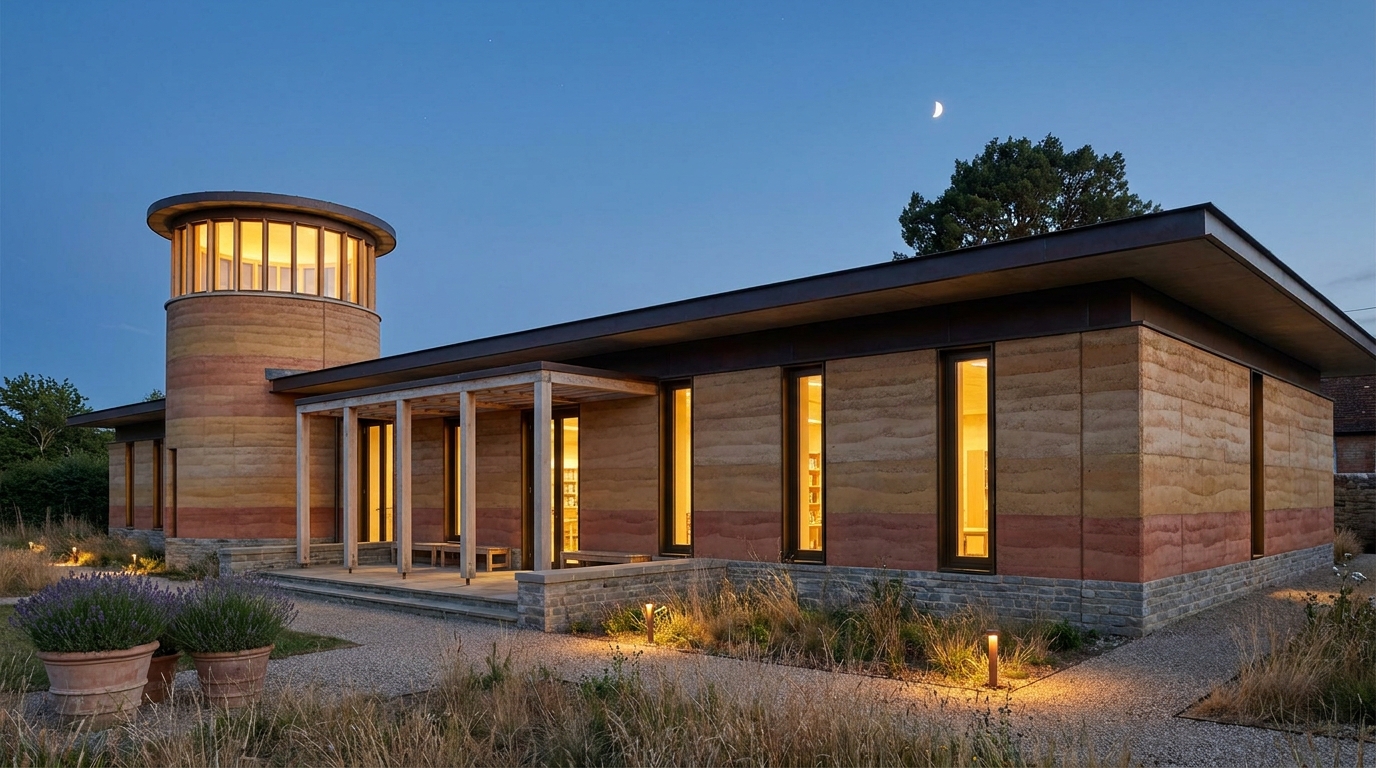
Photoreal dusk view of the same rammed earth library from its reading garden: layered earth walls, the round reading tower lit like a lantern at the left end, a six-column timber pergola, lavender, grasses, and path lights. Step 3 of the Rammed Earth Village Library workflow.
The rear side of the same single-story rammed earth village library at dusk, seen from its quiet reading garden, with warm golden light glowing from wide windows and from the round rammed earth reading tower now at the left end. Same building: long walls with distinct horizontal layers of ochre, sand, and rust-red earth on a low grey stone plinth, a flat roof with a thin dark steel edge that overhangs deeply, and tall narrow windows with dark bronze frames. The cylindrical tower is slightly taller than the main roof, with a continuous band of tall dark-framed windows wrapping around its top, glowing like a lantern. Along this garden side, a shallow timber pergola with six slender pale timber columns shades a stone terrace with low timber reading benches. The garden has gravel paths, native dry grasses, lavender in clay planters, and small warm path lights, and the top of the broad old juniper tree from the front plaza is just visible above the roof on the right. Deep blue twilight sky with a thin crescent moon and the first stars. Photoreal architectural photography, landscape 16:9. No people, no text, no signs, no cars.
Opinionated preferences for branching, commits, pull requests and releases in a trunk-based Git workflow.
# Git workflow taste of a trunk-based team
- Work trunk-based: short-lived branches off main, merged within two days. Confidence: 0.90
- Name branches as <type>/<short-topic>, for example fix/login-redirect. Confidence: 0.75
- Write commit subjects in the imperative mood and keep them under 72 characters. Confidence: 0.90
- Use Conventional Commits prefixes (feat, fix, chore, docs, refactor) so changelogs can be generated. Confidence: 0.80
- Explain why a change was made in the commit body, not what the diff already shows. Confidence: 0.85
- Keep each commit buildable and focused on one logical change. Confidence: 0.85
- Rebase your branch onto main instead of merging main into it. Confidence: 0.80
- Squash-merge pull requests so main has one commit per change. Confidence: 0.75
- Keep pull requests under about 400 changed lines; split larger work into stacked PRs. Confidence: 0.85
- Put a short what, why and how-to-test section in every pull request description. Confidence: 0.85
- Require one approving review and green CI before merging to main. Confidence: 0.90
- Protect main: no direct pushes and no force pushes. Confidence: 0.95
- Only force push your own branch, and always with --force-with-lease. Confidence: 0.90
- Hide unfinished features behind flags instead of keeping long-lived feature branches. Confidence: 0.85
- Tag releases with semantic version tags such as v1.4.2 on main. Confidence: 0.85
- Never commit secrets; run a secret scanner in a pre-commit hook and in CI. Confidence: 0.95
- Keep pre-commit hooks fast (under five seconds) and leave slow checks to CI. Confidence: 0.80
- Use a .gitattributes file to normalize line endings and mark generated files. Confidence: 0.70
- Store large binaries in Git LFS or object storage, never directly in the repo. Confidence: 0.85
- Use git bisect with a scripted test to hunt down regressions. Confidence: 0.70
- Revert a bad commit on main first and investigate afterwards. Confidence: 0.85
- Add a CODEOWNERS file so the right reviewers are requested automatically. Confidence: 0.75
- Delete branches automatically after they are merged. Confidence: 0.90
Build an image-ready and motion-ready brief for one hero shot of an old stone watermill on a stream: architecture, waterwheel, water and landscape, light and mist, fixed details, a motion map, and two prompt seeds: a 16:9 still image and an image-to-video animation.
Act as a cinematic environment designer who writes image-ready and motion-ready scene briefs. Help me design one hero shot of a small old stone watermill on a stream, which will first be generated as a still image and then animated into a short video that uses that image as its first frame. Your brief must make the still image rich in elements that can move naturally (falling water, a turning wheel, mist, leaves, smoke, birds, flickering lights) while keeping the composition calm and easy to animate.

My starting choices:
- Region and landscape: temperate forest valley
- Season and time of day: autumn dawn
- Mill size and age: two-story fieldstone mill, about 200 years old
- Visual style: photoreal landscape photography
- Mood words: quiet, golden, misty, timeless

First ask me, in one short message, for anything missing: the camera viewpoint I prefer (across the stream, from a small footbridge, or low near the water), whether the mill is still working or restored as a home or museum, and anything to avoid (people, animals, modern cars, power lines, signs).

Then produce the brief with these sections:

1. **Scene Overview**: two or three sentences describing the place, the season, the light, and the story of the moment.

2. **Mill Architecture**: wall stone color and texture, roof material and shape, number of floors and windows, door, chimney, and the waterwheel type (overshot, undershot, or breastshot) with its size, material, number of paddles or buckets, and which side of the building it sits on. Include the wooden chute or millrace that feeds it.

3. **Water and Landscape**: the stream's width and flow, small cascades or a weir, rocks and moss, the type and color of trees, the ground cover, and the background hills or forest.

4. **Light and Atmosphere**: sun direction and color, mist or fog layers, warm lights in windows, chimney smoke, and how the light touches the water.

5. **Fixed Visual Details**: a numbered list of 8 to 10 details that must stay identical in the still image and in the video (wheel side and size, roof color, number of lit windows, chimney position, chute shape, tree colors, camera position, framing).

6. **Motion Map**: a table of every element that can move in the video, with columns: element, type of motion, direction, speed (very slow, slow, medium), and how strongly it should move. Include the camera move. Keep total motion subtle and physically plausible.

7. **Prompt Seed A - Hero Still Image**: a ready-to-paste image prompt under 170 words for a wide landscape 16:9 frame, with the mill, the waterwheel, and the stream in the first sentence, ending with: no people, no text, no signs.

8. **Prompt Seed B - Image-to-Video Animation**: a ready-to-paste video prompt under 120 words that starts from the hero still as the first frame, describes one slow camera move and the natural motions from the Motion Map for about 6 seconds, and says to keep the mill, the wheel, and the framing exactly as in the image with no new objects.

Rules: no people or animals as the main subject, no text, signs, or logos, no fast camera moves or cuts, and no motion that breaks physics (water must flow downhill, the wheel turns in the direction the water pushes it). Use short paragraphs and lists.
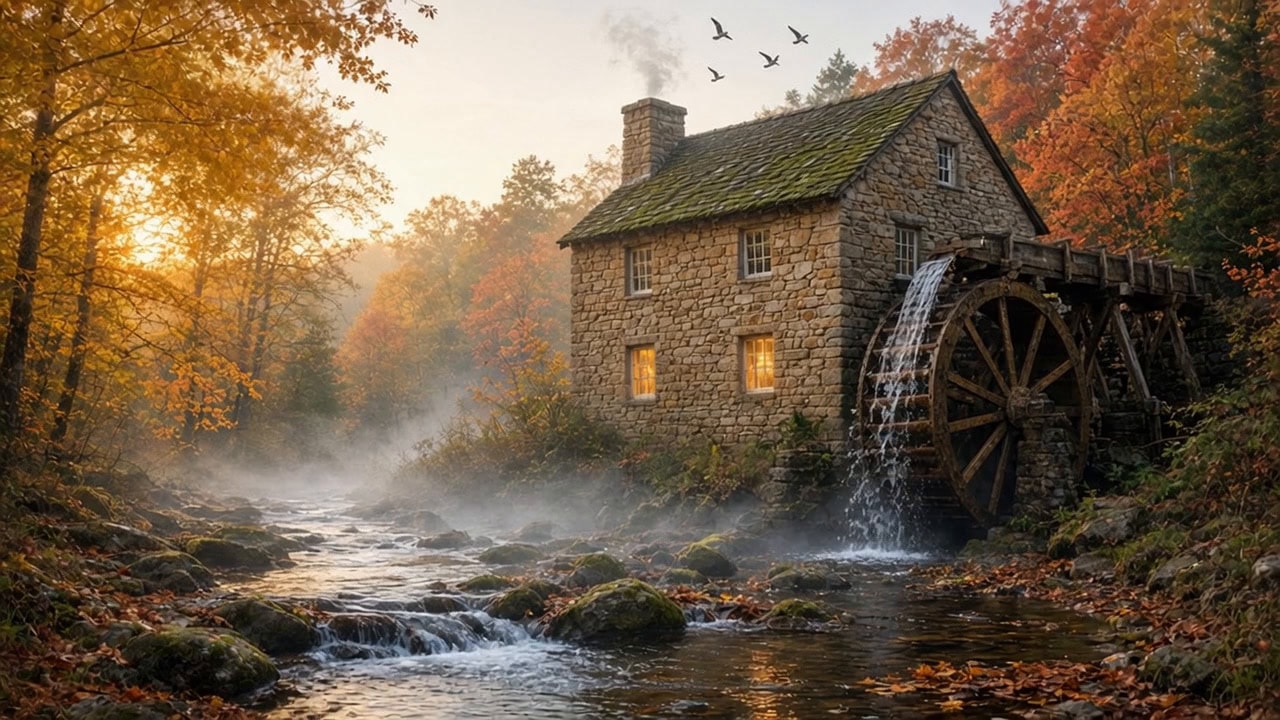
Photoreal autumn dawn shot of an old fieldstone watermill with a wooden overshot waterwheel and chute, a mossy slate roof, glowing windows, chimney smoke, a small rocky cascade, low mist, and maples in orange and gold. Step 2 of the Stone Watermill workflow.
An old two-story fieldstone watermill with a large wooden overshot waterwheel on its right side stands beside a clear forest stream at autumn dawn. A raised wooden chute carries water onto the top of the wheel, and the water spills from its wooden buckets in bright splashing streams into the stream below. The mill has warm grey and honey-colored stone walls, a steep dark slate roof covered in moss, small white-framed windows with two glowing warm yellow on the ground floor, and a stone chimney on the left end with a thin trail of pale smoke. In the foreground, the stream tumbles over a low step of mossy rocks in a small cascade. Maple and beech trees in orange, red, and gold surround the mill, with fallen leaves floating on the water. Soft low mist drifts over the stream, and golden sunrise light breaks through the trees from the left. A few small birds fly in the pale sky above the roof. Photoreal landscape photography, calm and timeless mood. Wide landscape 16:9. No people, no text, no signs, no cars.
Animate the step 2 watermill image as the first frame into a calm 6-second shot: the overshot wheel turns under the chute, the stream foams over mossy rocks, mist drifts, leaves fall, chimney smoke curls, and the camera slowly pushes in. Step 3 of the Stone Watermill workflow.
Start from the step 2 image "Stone Watermill on a Forest Stream at Autumn Dawn" as the exact first frame, and animate it into a calm 6-second cinematic shot. Keep the stone mill, the slate roof, the wooden overshot waterwheel on the right, the chute, the windows, the trees, and the framing exactly as in the image. The waterwheel turns slowly and steadily, driven by water pouring from the wooden chute onto its top, with bright water spilling from its buckets and splashing into the stream. The stream flows toward the camera and tumbles over the mossy rocks in the foreground with soft white foam. Low mist drifts slowly across the water from left to right. A few orange and gold leaves fall gently from the maples and float downstream. Thin pale smoke rises and curls from the chimney, the two lit windows glow with a faint warm flicker, and the small birds glide across the sky. Golden dawn light slowly brightens. The camera makes one very slow, smooth push-in toward the mill. Natural, realistic motion, no cuts, no new objects, no people, no text.Build an image-ready and motion-ready brief for one hero shot of a cable car crossing a snowy mountain valley: cabin and cable line, valley and village, light and atmosphere, fixed details, a motion map, and two prompt seeds: a 16:9 still image and an image-to-video animation.
Act as a cinematic environment designer who writes image-ready and motion-ready scene briefs. Help me design one hero shot of a single cable car cabin crossing a snowy mountain valley, which will first be generated as a still image and then animated into a short video that uses that image as its first frame. Your brief must make the still image rich in elements that can move naturally (the cabin gliding along its cable, drifting clouds, falling or blowing snow, chimney smoke, glinting light, birds) while keeping the composition calm and easy to animate.

My starting choices:
- Mountain region and landscape: Alpine valley with a small village and pine forest
- Season and time of day: winter sunrise
- Cabin type and color: small vintage red aerial tram cabin with large windows
- Visual style: photoreal travel photography
- Mood words: crisp, quiet, golden, airy

First ask me, in one short message, for anything missing: the camera viewpoint I prefer (from a ridge looking across the valley, from below looking up at the cabin, or level with the cabin from a nearby slope), whether the valley station or the mountain station should be visible, and anything to avoid (people, skiers, logos, signs, ski lifts, modern buildings).

Then produce the brief with these sections:

1. **Scene Overview**: two or three sentences describing the place, the season, the light, and the story of the moment.

2. **Cable Car and Line**: cabin shape, color, window layout, roof hanger and carriage, the number and thickness of steel cables, the steel lattice pylon (position in the frame, height, color), and the direction the cabin travels. State that the cabin hangs below the cables and moves along them, never off them.

3. **Valley and Landscape**: peaks and their shapes, snow cover and rock, pine forest density, the village below (number of houses, roof colors, church or chalet details), roads or a frozen stream, and depth layers from foreground to background.

4. **Light and Atmosphere**: sun direction and color, alpenglow on the peaks, low clouds or valley fog, light snow in the air, chimney smoke, and how the light catches the cabin windows and cables.

5. **Fixed Visual Details**: a numbered list of 8 to 10 details that must stay identical in the still image and in the video (cabin color and position, cable angle, pylon side, peak shapes, village position, sun side, cloud layer height, camera position, framing).

6. **Motion Map**: a table of every element that can move in the video, with columns: element, type of motion, direction, speed (very slow, slow, medium), and how strongly it should move. Include the camera move. Keep total motion subtle and physically plausible.

7. **Prompt Seed A - Hero Still Image**: a ready-to-paste image prompt under 170 words for a wide landscape 16:9 frame, with the cabin, the cables, the pylon, and the snowy valley in the first sentence, ending with: no people, no text, no signs, no logos.

8. **Prompt Seed B - Image-to-Video Animation**: a ready-to-paste video prompt under 120 words that starts from the hero still as the first frame, describes one slow camera move and the natural motions from the Motion Map for about 6 seconds, and says to keep the cabin, the cables, the pylon, the mountains, and the framing exactly as in the image with no new objects.

Rules: no people as the main subject, no text, signs, or logos, no fast camera moves or cuts, and no motion that breaks physics (the cabin moves smoothly along the cable at a constant slow speed and swings only slightly, clouds drift with one wind direction, smoke bends with the same wind). Use short paragraphs and lists.
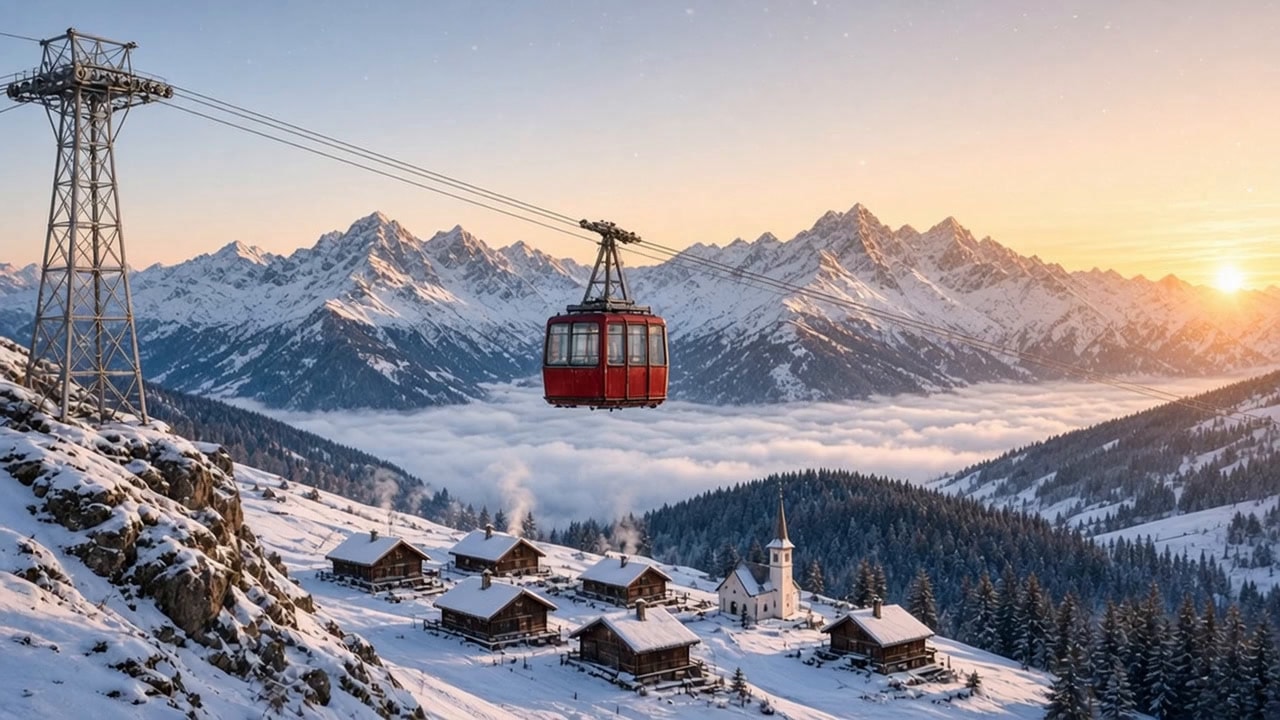
Photoreal winter sunrise shot of a vintage red cable car cabin on two steel cables crossing a snowy Alpine valley, a lattice pylon on the left, a chalet village with chimney smoke, pines, low valley cloud, and peaks glowing with alpenglow. Step 2 of the Alpine Cable Car workflow.
A small vintage red cable car cabin with large windows hangs from two steel cables and crosses a snowy Alpine valley at winter sunrise, moving from left to right, with a tall grey steel lattice pylon standing on a snowy rock outcrop on the left of the frame. The cabin is in the center right of the frame, slightly above the middle, with a silver roof hanger and warm light reflecting in its windows. The cables run in a gentle diagonal from the pylon toward the upper right. Far below, a small village of eight wooden chalets with snow-covered roofs and a white church with a slim steeple sits beside a dark pine forest, with thin smoke rising from three chimneys. Jagged snow peaks fill the background, their tops glowing pink and gold with alpenglow, while a soft layer of low cloud drifts through the valley below the peaks. Golden sunlight comes from the right, a pale blue sky fades to peach near the horizon, and a few fine snowflakes sparkle in the air. Photoreal travel photography, crisp and quiet mood. Wide landscape 16:9. No people, no text, no signs, no logos.
Animate the step 2 cable car image as the first frame into a calm 6-second shot: the red cabin glides along the cables, light glints on its windows, valley clouds and chimney smoke drift, fine snow sparkles, alpenglow warms, and the camera slowly pans with the cabin. Step 3 of the Alpine Cable Car workflow.
Start from the step 2 image "Red Alpine Cable Car Above a Snowy Valley at Winter Sunrise" as the exact first frame, and animate it into a calm 6-second cinematic shot. Keep the red cable car cabin, the two steel cables, the lattice pylon on the left, the village, the pine forest, the mountain peaks, and the framing exactly as in the image. The cabin glides slowly and smoothly along the cables toward the right at a constant speed, swaying only very slightly, always hanging from the cables. Sunlight glints softly across its windows and along the cables. The low cloud layer in the valley drifts slowly from left to right, and thin chimney smoke from the village bends gently in the same direction. A few fine snowflakes float and sparkle in the air. The alpenglow on the peaks slowly warms and brightens. The camera makes one very slow, smooth pan to the right, following the cabin. Natural, realistic motion, no cuts, no new objects, no people, no text.Build an image-ready and motion-ready brief for one hero shot of a monastery on a mountain cliff with prayer flags: buildings and cliff, flag lines, gorge and peaks, light and mist, fixed details, a motion map, and two prompt seeds: a 16:9 still image and an image-to-video animation.
Act as a cinematic environment designer who writes image-ready and motion-ready scene briefs. Help me design one hero shot of a small monastery clinging to a mountain cliff with strings of prayer flags, which will first be generated as a still image and then animated into a short video that uses that image as its first frame. Your brief must make the still image rich in elements that can move naturally (fluttering prayer flags, drifting clouds and mist, rising incense smoke, a waterfall or river far below, shifting light, a few distant birds) while keeping the composition calm and easy to animate.

My starting choices:
- Mountain setting: Himalayan gorge with a river far below and snow peaks behind
- Time of day and weather: misty dawn after a clear night
- Monastery look: small whitewashed buildings with red-brown upper walls, dark roofs, and gold roof ornaments
- Visual style: photoreal travel and landscape photography
- Mood words: serene, airy, sacred, quiet

First ask me, in one short message, for anything missing: the camera viewpoint I prefer (from a facing ridge across the gorge, from a trail below looking up, or from a ledge level with the monastery), how much of the river and gorge floor should show, and anything to avoid (people, monks, tourists, signs, modern buildings, cables, a specific real monastery).

Then produce the brief with these sections:

1. **Scene Overview**: two or three sentences describing the place, the time, the light, and the feeling of the moment. Describe an imagined monastery, not a copy of a real, named one.

2. **Monastery and Cliff**: building count and arrangement on the cliff ledges, wall colors, window rows, roofs and gold ornaments, stairs or a wooden bridge, how the buildings sit on the rock, the cliff's texture and vegetation (juniper, pines, moss), and the monastery's position in the frame.

3. **Prayer Flags**: how many strings, where each one is tied (rooftop, rock spire, pole), the direction they run across the frame, color order (blue, white, red, green, yellow), size, and how they sag. State that the flags move with the wind but their tie points never move.

4. **Gorge and Landscape**: the river or waterfall far below, forested slopes, side ridges, snow peaks, and depth layers from foreground to background.

5. **Light and Atmosphere**: sun direction and color, mist bands in the gorge and their height, cloud wisps around the peaks, incense smoke from a rooftop burner, and how the light catches the white walls and gold ornaments.

6. **Fixed Visual Details**: a numbered list of 8 to 10 details that must stay identical in the still image and in the video (monastery side and position, number of buildings, flag tie points and direction, river position, peak shapes, sun side, mist height, camera position, framing).

7. **Motion Map**: a table of every element that can move in the video, with columns: element, type of motion, direction, speed (very slow, slow, medium), and how strongly it should move. Include the camera move. Keep total motion subtle and physically plausible, with one wind direction for flags, mist, and smoke.

8. **Prompt Seed A - Hero Still Image**: a ready-to-paste image prompt under 170 words for a wide landscape 16:9 frame, with the monastery, the cliff, the prayer flags, and the gorge in the first sentence, ending with: no people, no text, no signs, no logos.

9. **Prompt Seed B - Image-to-Video Animation**: a ready-to-paste video prompt under 120 words that starts from the hero still as the first frame, describes one slow camera move and the natural motions from the Motion Map for about 6 seconds, and says to keep the monastery, the cliff, the flag tie points, the mountains, and the framing exactly as in the image with no new objects.

Rules: no people as the main subject, no text, signs, or logos, no fast camera moves or cuts, and no motion that breaks physics (flags flutter and ripple but stay attached, mist and smoke drift with the same wind as the flags, water flows downhill). Use short paragraphs and lists.
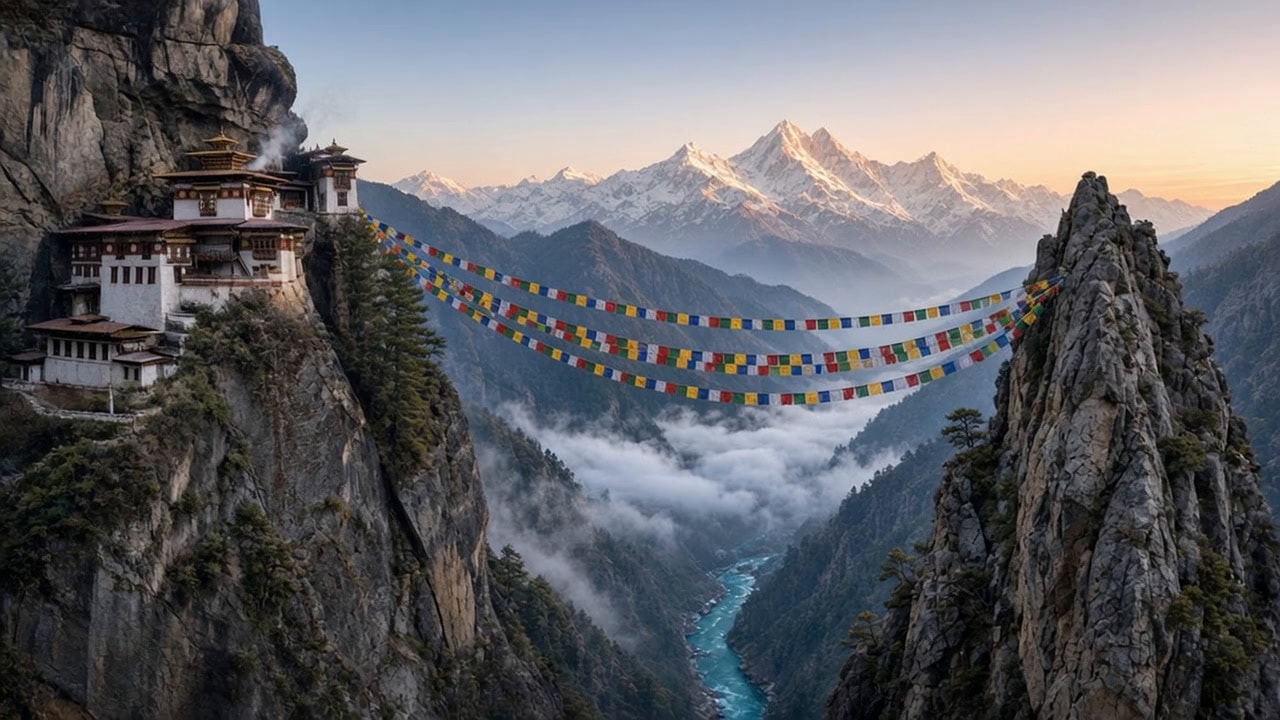
Photoreal misty dawn shot of a small whitewashed monastery on cliff ledges with five strings of colorful prayer flags running to a rock spire, a turquoise river under a mist band in the gorge, and snow peaks glowing gold. Step 2 of the Himalayan Cliffside Monastery workflow.
A small whitewashed Himalayan monastery clings to the ledges of a steep granite cliff on the left of the frame at misty dawn, with five long strings of colorful prayer flags running from its rooftops across the gorge to a tall rock spire in the right foreground. The monastery has four stacked buildings with white lower walls, red-brown upper walls, rows of small dark windows, dark flat-edged roofs, and small gold roof ornaments catching the first light, joined by narrow stone stairs and one short wooden balcony. Thin incense smoke rises from a rooftop burner. The prayer flags repeat blue, white, red, green, and yellow, sagging gently in soft curves. Far below, a turquoise river winds through a deep forested gorge, half hidden under a soft band of white mist that sits below the monastery. Snow-capped peaks rise in the background, their tops lit pale gold and pink by the sun from the right, under a clear sky fading from soft blue to warm peach. Dark pines and juniper bushes cling to the rock. Photoreal travel and landscape photography, serene and airy mood. Wide landscape 16:9. No people, no text, no signs, no logos.
Animate the step 2 monastery image as the first frame into a calm 6-second shot: prayer flags flutter in the breeze, the gorge mist drifts and thins over the river, incense smoke bends with the wind, dawn light warms the walls and peaks, and the camera slowly pushes in. Step 3 of the Himalayan Cliffside Monastery workflow.
Start from the step 2 image "Cliffside Himalayan Monastery with Prayer Flags at Misty Dawn" as the exact first frame, and animate it into a calm 6-second cinematic shot. Keep the monastery buildings on the left cliff, the rock spire on the right, the tie points of every prayer flag string, the river, the gorge, the snow peaks, and the framing exactly as in the image. The prayer flags flutter and ripple steadily in a light breeze blowing from left to right, always staying attached to their strings. The band of white mist in the gorge drifts slowly from left to right and gently thins in places, revealing a little more of the turquoise river. Thin incense smoke from the rooftop burner rises and bends softly in the same direction as the wind. Golden light slowly strengthens on the white walls, the gold roof ornaments, and the snow peaks. The camera makes one very slow, smooth push-in toward the monastery. Natural, realistic motion, no cuts, no new objects, no people, no text.